



Ask most association leaders whether they’re “using AI” and you’ll get a hesitant answer. Somewhere in the organization, someone is probably experimenting with a chatbot for member questions or an AI tool to draft renewal emails. But ask a more specific question: can you pull a single, accurate view of a member’s renewal status, event history, and payment record in under a minute?. And the hesitation usually turns into a wince.
That gap is the real story behind AI adoption in the association world. AI association management software doesn’t fail because the models aren’t smart enough. It fails because the data underneath it is scattered across spreadsheets, a payment processor, an event platform, an email tool, and a CRM that don’t talk to each other. Before AI can help an association work smarter, the association has to solve a much less glamorous problem: getting its member data into one place, in a consistent format, that a system (human or artificial) can actually trust.
To go deeper on this topic, check out our webinar on How to Improve Member Experience with Data, AI & Member-Centric Approach, where Salesforce and Advanced Communities experts break down how associations are using AI and Agentforce to personalize engagement and modernize member operations.
Table of Contents
Why Spreadsheets Still Hold Associations Back
Spreadsheets got associations through the early stages of membership management, and for a small organization with a few hundred members, they can still feel manageable. The trouble starts as membership grows and more people touch the data. A membership coordinator maintains one file for renewals. Finance keeps a separate ledger for payments. The events team tracks registrations in yet another tab, often in a different tool entirely. Each file reflects a partial, aging snapshot of reality, and none of them updates the others.
The practical consequences are familiar to almost anyone who has run association operations: a lapsed member gets a renewal thank-you email because two spreadsheets disagreed about their status; a board report takes three days to assemble because the numbers have to be reconciled by hand; a staff member who understands “the real version” of a file goes on leave and operations quietly stall. None of this is a people problem, but a structural one. Spreadsheets were never designed to hold a living, constantly updated record of thousands of relationships.
This is also why AI initiatives so often stall before they start. A predictive model or a recommendation engine needs consistent, connected records to learn from. Fed a patchwork of disconnected files, it can’t tell a renewed member from a lapsed one, or a donor from a first-time event attendee. Associations frequently discover this the hard way, only after they’ve already tried to layer membership management software integrations on top of tools that were never built to be connected in the first place.
What “AI-Ready Membership Management” Actually Means
“AI-ready” is often misunderstood as a shopping decision: buy the tool with AI in the name and the problem is solved. In practice, it’s closer to a data discipline than a purchase. An association is AI-ready when its membership data has a few specific properties, regardless of which platform holds it:
- Clean, de-duplicated member records rather than multiple partial profiles for the same person
- A single source of truth that every team references, instead of parallel spreadsheets
- Connected member profiles that link renewals, payments, event activity, and communications to one identity
- Structured engagement history (not just “this person is a member,” but a timeline of what they’ve done)
- Working segmentation, so members can be grouped meaningfully for outreach or analysis
- Reporting and dashboards that reflect current reality, not a snapshot from last quarter
None of this requires artificial intelligence. It’s ordinary data hygiene, applied consistently. But it’s the precondition for AI to be useful at all. This is also where the distinction from a general association management system matters: having an AMS doesn’t automatically mean the data inside it is AI-ready. A system can technically hold all the right fields and still be full of duplicates, gaps, and disconnected records if governance was never built in.
How AI Can Help Associations Once the Data Is Organized
This is where AI actually earns its place in association operations, not as an innovation, but as a layer that changes how much a small team can realistically do. In our experience supporting associations on Salesforce, the highest-value use cases fall into a few concrete categories.
Predicting renewal and retention risk
Instead of waiting for a member to lapse and then trying to win them back, AI can surface early warning signs: a drop in event check-ins, no recent portal logins, an unanswered communication thread, while there’s still time to act. That turns renewal outreach from a blanket campaign sent to everyone into a targeted list of the members most likely to need a nudge, which is a meaningfully different (and more effective) way of automating membership renewals than a single reminder email sent on a fixed schedule.
Personalizing engagement at a scale staff can’t match manually
Most associations know, in general terms, which members care about advocacy, which show up for education content, and which are mainly there for networking. AI makes it practical to act on that at an individual level, tailoring which content, events, or renewal messaging a given member sees, instead of sending the same newsletter to everyone and hoping it lands. That’s the shift at the center of most modern member engagement strategies: less broadcasting, more relevance.
Powering member-facing self-service
AI agents can now handle a real share of routine member questions directly inside a self-service portal, checking renewal status, updating contact details, finding an event, or answering common membership policy questions without a staff member touching every ticket. For associations with lean teams, this is often the most immediately visible win: response times drop for the simple questions, freeing staff for the ones that actually need a human.
Giving staff a shortcut through reporting and busywork
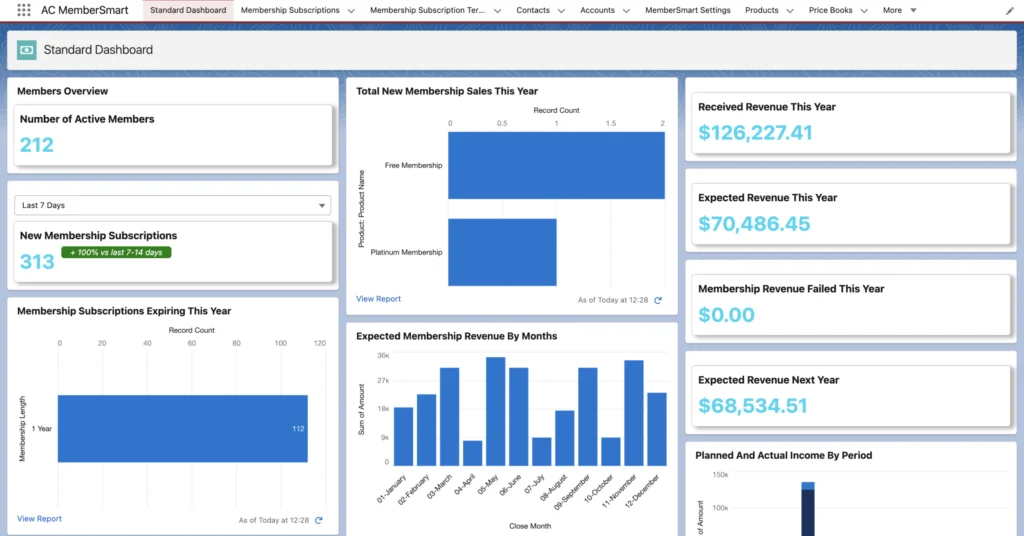
Board reports, engagement summaries, and campaign recaps are exactly the kind of repetitive synthesis AI is good at, once it has real data to pull from. Rather than a staff member spending a day reconciling numbers before a board meeting, a well-set-up system can generate a first draft of that summary in minutes, along with a reasonable next-best action for a given account.
Sharpening fundraising and donor outreach
Where membership and donation data live together, AI can connect the dots, recognizing that a long-time member’s giving pattern has shifted, or that a segment of engaged members has never been asked to donate in a way that would take a development team much longer to spot manually.
It’s worth being direct about the limits here too: there’s no universal multiplier for renewal rates or engagement that applies across every association, and any vendor citing one without a source is worth being skeptical of. The realistic payoff is fewer missed renewals, faster reporting, and staff time redirected from data wrangling toward actual relationships, which, for most associations, is already a significant shift.
What AI Cannot Fix Without Better Data
It’s worth being direct about the limits, because overselling AI is part of what makes associations distrust it. AI cannot compensate for member profiles that are incomplete, duplicated, or contradictory. If payment and renewal data live in separate systems that don’t reconcile automatically, no model can bridge that gap reliably. It will simply produce confident-sounding output based on incomplete information, which is arguably worse than no automation at all.
The same is true if engagement isn’t tracked anywhere in a structured way. An AI tool can’t identify an at-risk member if event attendance, portal activity, and communication history were never captured as data in the first place. And if there’s no consistent process for keeping records updated, any AI-driven recommendation degrades quickly as the underlying data goes stale. It’s the same problem that undermines automating membership renewal efforts when they’re built on inconsistent data to begin with. The pattern is consistent: AI reflects the quality of the system it’s layered onto. It doesn’t correct for a broken one.
How Salesforce Puts AI to Work for Associations: The Role of a Single Source of Truth
Salesforce’s native AI tools, including Agentforce, are built to act on data that already lives within the Salesforce object model, which is exactly the setup most associations lack when their membership data is spread across separate spreadsheets and standalone tools. When renewals, payments, events, and engagement history sit in the same Salesforce org, those AI tools can act on a member record directly: flagging renewal risk, drafting a personalized outreach message, or answering a member’s self-service question, without a manual export or a sync job in between.
That’s a meaningfully different starting point than bolting a standalone AMS onto Salesforce as a connected-but-separate system, where AI tools either can’t reach the membership data at all or only see a partial, delayed copy of it. Salesforce membership management done natively is less about architecture for its own sake and more about giving AI something real to act on.
Practical Checklist: Getting Ready to Put AI to Work
None of this needs to happen overnight, and the order matters more than the speed:
- Pick one AI use case to start with: renewal risk flagging is usually the easiest to measure and the fastest to show value
- Audit the data that use case depends on: for renewal risk, that means renewal status, payment history, and engagement activity
- Remove duplicates and connect the records: merge duplicate member profiles and make sure payments and renewals reference the same record
- Start tracking engagement as data: portal logins, event attendance, and email activity, captured consistently rather than anecdotally
- Turn on the AI feature for a small segment first: a single membership tier or region and check the recommendations against what staff already know
- Expand once the results hold up: widen the segment, then add a second use case, like personalized engagement or reporting automation
Associations that skip straight to buying an AI tool without this sequence tend to end up with recommendations nobody trusts, because the tool is only ever as reliable as the records feeding it.
Curious whether your current setup is closer to AI-ready than you think or further? A short conversation with our team is usually enough to tell.
How AC MemberSmart Helps Associations Build an AI-Ready Membership System
AC MemberSmart is a Salesforce-native association management system, which means the AI capabilities Salesforce offers, including Agentforce, have real membership data to act on from day one: member profiles, renewals, payments, event history, and donations all live in the same org rather than across disconnected tools. That’s what makes practical AI use cases achievable rather than theoretical: flagging renewal risk based on actual engagement patterns, giving members a self-service portal that can answer routine questions directly, and generating reporting that reflects current data instead of a monthly export.
For associations still running on spreadsheets, or on an AMS that sits bolted onto Salesforce as an add-on, that native setup is the difference between an AI feature that’s genuinely useful and one that just looks good in a demo. You can see the full picture of how the platform is structured on the AC MemberSmart features page.
Conclusion
AI can genuinely help associations work more efficiently, flagging renewal risk, personalizing outreach, saving hours on reporting. But none of that happens by installing a tool on top of chaos. It happens after an association has done the less exciting work of consolidating, cleaning, and connecting its member data into a single, trustworthy source. Get that foundation right, on Salesforce or otherwise, and AI stops being a buzzword and starts being a genuinely useful layer on top of operations that already work.
See how AC MemberSmart helps associations move from spreadsheets and disconnected tools to a Salesforce-native membership management system. Book a personalized demo.
FAQ
Do we need AI association management software if we're still using spreadsheets?
Not yet. And buying AI tools before consolidating your data usually wastes the investment. The first priority is getting member data into a single, connected system. AI features are worth evaluating once that foundation is in place, not before.
How long does it take to move from spreadsheets to a single source of truth?
It depends heavily on the size of the membership base and how many disconnected tools are currently in use. Most associations see the biggest jump in data quality within the first few months of consolidation. Deduplication and defining core fields tend to be the fastest wins.
Can AI fix duplicate or incomplete member records automatically?
AI can help flag likely duplicates or gaps for review, but it can’t reliably resolve them without human judgment, especially for nuanced cases. Data cleanup is still largely a deliberate, structured process rather than something to fully automate away.
Does AC MemberSmart include AI features?
AC MemberSmart is built natively on Salesforce, which means associations using it can take advantage of Salesforce’s own AI and automation tools, including Agentforce, because member, renewal, payment, and event data already live in a single connected data model.