


Almost every association management system now carries an “AI-powered” label. It shows up on product pages, in RFP responses, and in nearly every vendor demo. The label alone tells you very little, though. An AMS can call itself AI-powered because it has a chat window that summarizes help articles, or because its AI can reach into member records, build a report, and start a renewal process. Those are two very different products.
For associations evaluating AI association management software, or planning to replace an aging system, the useful question is more practical: can the AI work with actual member data, business rules, and workflows, or can it only answer questions about them?
Below, we look at what AI in an AMS should realistically be able to do, why the architecture underneath matters as much as the AI itself, and how a Headless AMS changes the way staff interact with the system. We’ll also show how AC MemberSmart approaches this on Salesforce.
Adding AI to an AMS Is Not the Same as Building an AI-Ready AMS
Most AI in association technology today falls into one of two categories, and the difference rarely shows up in a feature list.
The first is AI added on top. A vendor connects a language model to the existing product, usually through a chat panel or assistant. This kind of AI can be genuinely useful. It answers general questions, explains documentation, drafts emails or event descriptions, and points users to the right screen. What it typically can’t do is touch the records, reports, or processes that run the association. It sits next to the system and talks about it.
The second is AI integrated into the AMS environment. Here, AI has a path into the system’s core: member data, reports, permissions, workflows, automation, and the business logic that ties them together. When this is designed well, a staff member can ask for something and the system can actually retrieve, prepare, or change it.
Integration is a design goal, though, and not every system that claims it delivers all of it. Some products connect AI to data but not to workflows. Others can read records but have no reliable way to respect user permissions. So when a vendor says its AMS has AI, the follow-up worth asking is what that AI can actually reach, and under whose rules.
What AI in an AMS Should Actually Be Able to Do
If AI is going to earn its place in an AMS, it has to help staff do the work, beyond describing how the work is done. Four capabilities separate operational AI from a smarter help menu.
Work With Association Data
Take a common question from a membership team: Which members have high engagement but are approaching renewal?
An assistant layered on top would probably explain how to find the answer: open the member list, filter by expiration date, cross-check event attendance, maybe export everything to a spreadsheet. Helpful, but the staff member still does all the work.
AI that works with association data should return the actual list. It needs to understand what engagement means in this organization’s data (event attendance, committee roles, community activity, course completions) and what “approaching renewal” means in terms of membership dates. Then it should produce the members, with enough context to act on.
Turn Questions Into Reports
Reporting is where many associations feel the friction most. Building a useful report in a traditional AMS means knowing which objects hold the data, which fields matter, which report type supports the right relationships, and how to set filters without dropping records by accident. Most staff don’t have that knowledge, so requests pile up with an admin or a consultant.
AI-powered reporting should shorten the path to three steps: a business question, the relevant data, a usable report. An education director might ask how many members who completed a certification course last year have registered for this year’s annual conference. She shouldn’t need to know what the course enrollment object is called or how it relates to event registrations. The system should know that, build the report, and let her refine it in plain language.
Help Turn Business Outcomes Into Workflows
Workflows are where AI moves from insight to action. Consider new member onboarding. An association may want every new member to complete a profile, join a community group, and attend an orientation session within their first month. Done manually, someone has to:
- Identify members who joined recently
- Check which onboarding steps each one has completed
- Prepare personalized follow-up for those who haven’t finished
- Update their onboarding status as they progress
- Send certain actions, such as a fee waiver or a membership upgrade, for staff approval
Automating this has traditionally meant writing requirements and waiting for an admin or developer to build the flow. With natural language workflows, a staff member can describe the outcome (“make sure new members finish onboarding in their first month and flag anyone who falls behind”), and AI can help translate it into steps, conditions, and approvals. People define what should happen. AI helps work out how.
Reduce Dependence on Navigation
Every traditional AMS is organized around screens. To get something done, you need to know where it lives: which tab, which related list, which setup menu. New staff spend weeks learning that map, and experienced staff still lose time to it.
AI changes the starting point. A user begins with “What do I need to accomplish?” instead of “Where is this setting?” That move from navigation-driven to intent-driven interaction sounds small, but it changes who can use the system well. A chapter coordinator who logs in twice a month shouldn’t have to relearn the interface every time.
Why Headless Architecture Matters
The capabilities above raise an architectural question. If staff can ask for a report, start a workflow, or update a record through AI, what happens to the AMS itself?
This is where the Headless AMS comes in. In software design, “headless” describes a system whose core functions are separated from any single front end. Applied to association management, a Headless AMS keeps everything that makes the system dependable:
- Member data and the relationships between records
- Permissions and security rules
- Business logic, such as pricing, eligibility, and renewal terms
- Workflows and automation
- Integrations with finance, learning, events, and other systems
What changes is how people reach those capabilities. Going headless leaves the AMS interface in place, so staff who prefer record pages and dashboards still have them. The interface simply stops being the only way to use the AMS. A conversation with AI, a request from a phone, or a tool where staff already work can all reach the same core.
This is also what makes operational AI possible. AI needs a dependable layer of data, logic, and permissions to work against. When those live in the core, independent of any particular screen, AI can use them directly and follow the same rules as every other channel.
How AC MemberSmart Approaches Headless AMS
AC MemberSmart was built as the first Headless AMS, and its approach starts with the platform underneath. It’s a 100% Salesforce-native AMS, so member data, security, permissions, workflows, and automation all live in Salesforce. The headless model doesn’t require moving data into a separate AI system or keeping a parallel copy.
That foundation matters for three reasons. First, the data is already connected. Memberships, event registrations, payments, and engagement history sit in one Salesforce environment, so AI can follow the relationships between them. Second, permissions carry over. When a staff member asks AC MemberSmart for a report or a record update, the work happens under that person’s own Salesforce permissions, with no shortcut around the access rules the association has set. Third, workflows and automation run on the platform the association already relies on for daily operations.
On top of this foundation, AI acts as a new interaction layer. In practice, staff can:
- Describe the report they need and have AC MemberSmart build it, instead of configuring it field by field
- Describe a workflow outcome, such as sending different renewal emails to two audiences, and let the system handle the logic and record updates
- Ask how to do something, like setting up a student membership discount, and get the answer or have the task done
- Shape their workspace around how they work, surfacing what they use daily and hiding the rest
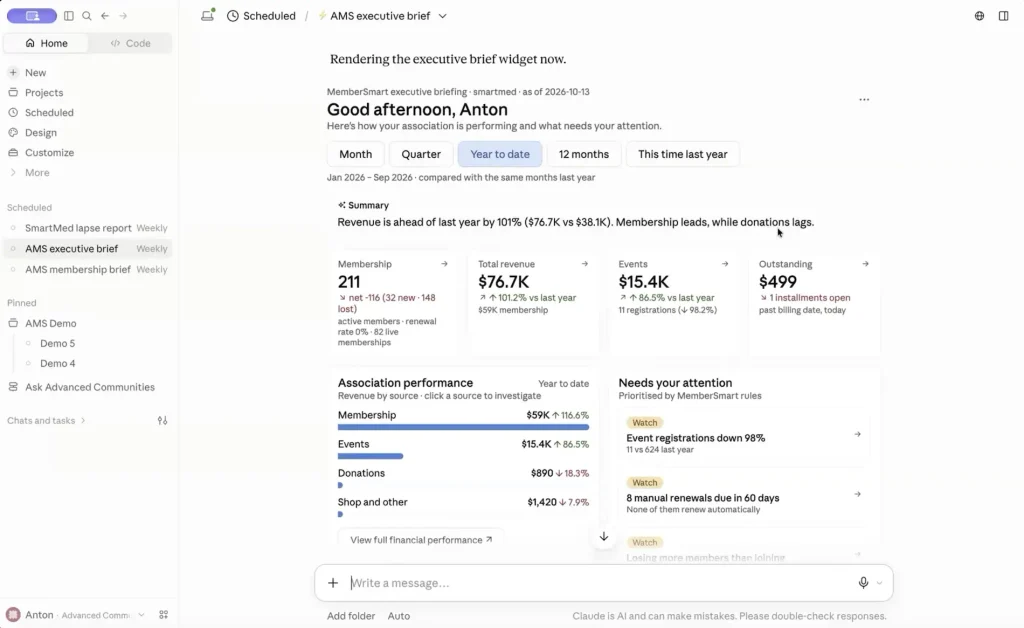
AC MemberSmart also offers a remote Salesforce MCP server that lets authorized users manage members by talking to Claude, including in voice mode on a phone. It’s a clear example of headless in practice: the AMS meets staff where they already are.
AI Still Needs Governance and Control
Once AI can reach real data and real workflows, the stakes go up, and any AI-powered AMS should be held to a clear set of controls. Permissions come first: the AI should see and do only what the requesting user is allowed to see and do. Member and financial data also needs the same security whether staff reaches it through a conversation or a screen.
Data quality matters just as much, because AI answers are only as good as the records behind them, and duplicate or outdated records lead to confident mistakes. Business rules such as eligibility, pricing, and renewal logic should be enforced by the system every time, so the outcome doesn’t depend on how a request was phrased.
Finally, actions with financial or reputational weight should wait for a human sign-off, and every action should leave an audit trail showing what was requested, what changed, and who started it.
The more an AI can do inside the AMS, the stronger these operational foundations need to be.
How Associations Should Evaluate AI in an AMS
Almost every vendor will answer yes to “Does your AMS have AI?”, so that question won’t help you compare options. These will tell you more during a demo or RFP:
- Can AI work with actual member data? Ask the vendor to answer a real question, like which members lapsed after attending an event, using live records.
- Can it work within existing permissions? Have two users with different access levels ask the same question and compare what each sees.
- Can it help build reports? Check whether a plain-language request produces a report staff can save, share, and refine.
- Can it help prepare workflows? Describe an outcome and watch how the system turns it into steps and conditions.
- Can it connect insights with actions? Finding at-risk members is half the job. See whether the system can move from that list to outreach or a status update.
- Where is human approval required? Ask which actions run automatically, which need sign-off, and who decides.
A vendor that can show all six live, in a working environment, is offering operational AI. One that can only show a chat window explaining features is offering a help assistant.
From AI Feature to a New Way of Working
The real shift AI brings to association management is a new sequence for getting work done: ask, understand, act. A staff member asks in plain language. The system understands the request in the context of the association’s data, rules, and permissions. Then it acts by returning the answer, building the report, or preparing the workflow for approval.
That sequence depends on architecture. Headless architecture keeps data, logic, and controls in a stable core while opening new ways to reach them, which makes it the foundation for this interaction model. Without that foundation, AI stays a feature attached to screens.
For associations weighing an AI-powered AMS, then, the question to settle goes beyond whether a system has AI. What matters is whether that AI can actually work with the data, logic, and workflows that run your association.
Explore how AC MemberSmart approaches Salesforce AMS with AI, or request a live demo to see a Headless AMS working with real association data.