


Here’s a scenario that will sound familiar to anyone running membership operations.
A member emails to say she didn’t receive her renewal reminder. You check your CRM, and she’s there, marked as active. But her renewal date is wrong. Finance has the correct date in their payments spreadsheet, but nobody synced it back. Meanwhile, she attended your annual conference two months ago, and that data lives in your event registration platform. Her email engagement stats? Sitting in Mailchimp, disconnected from everything else.
You have data. You just don’t have a picture.
This is the quiet crisis in association management. Most associations have accumulated data across five, six, sometimes ten different systems: an aging AMS, spreadsheets, a separate event tool, a payment processor, and an email platform. None of these talk to each other consistently. You can’t confidently answer “Which members are at risk of lapsing?” without spending hours pulling reports from multiple platforms and stitching them together manually.
This is where the member 360 view becomes not just useful, but essential.
Table of Contents
What Is a 360 Member View?
A member 360 view is a single, unified profile for each member that captures every meaningful interaction they’ve had with your organization from the day they first joined to their most recent activity.
It’s not just a contact card with a membership status. A contact record tells you who someone is. A 360 member view tells you what their relationship with your organization actually looks like: whether they renew on time, which events they attend, when they last logged in, whether they’ve donated, and whether they’ve raised a support request that was never resolved. That complete picture is the foundation for every meaningful decision in Salesforce membership management.
What Data Should Be Included in a 360 Member Profile?
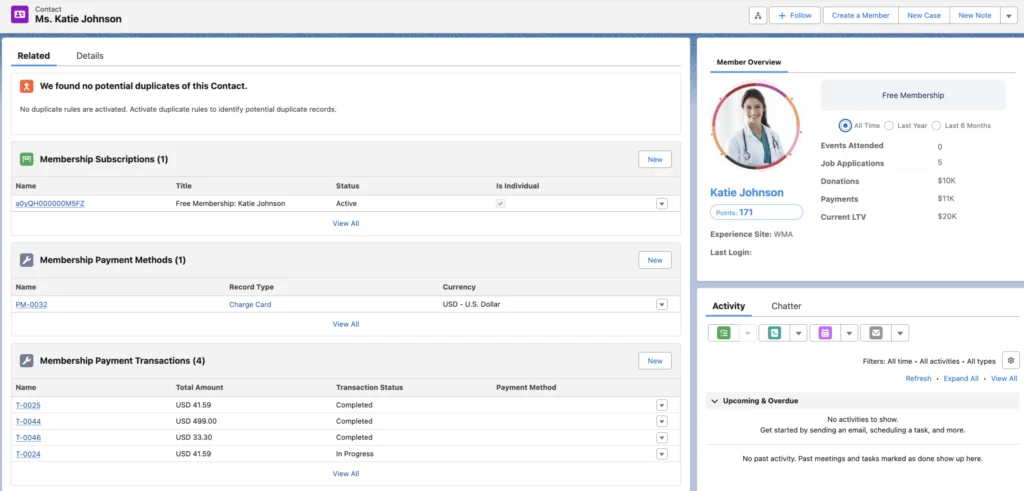
A complete member profile brings together data from across your operations. Not all of these will be relevant to every association, but this is the standard to work toward:
| Data Category | What to Capture |
| Contact Details | Name, email, phone, address, job title, employer, social profiles |
| Membership Type & Status | Individual, corporate, student; active, lapsed, grace period |
| Renewal Date & History | Upcoming renewal, past renewal dates, on-time vs. late patterns |
| Payment History | Dues paid, amount, method, outstanding balances |
| Event Registrations | Events registered for, whether they attended or no-showed |
| CPD/CPE Activity | Continuing education credits earned, courses completed |
| Donations | Amount, date, campaign, giving frequency |
| Job Board Activity | Posts viewed, applications made, job listings posted |
| Portal Logins | Last login date, login frequency, pages visited |
| Group/Community Activity | Forum participation, committee membership, interest groups |
| Communication Preferences | Email opt-ins, preferred channels, language preferences |
| Support Requests | Tickets raised, resolution status, recurring issues |
| Engagement Score | A composite metric reflecting overall activity and participation |
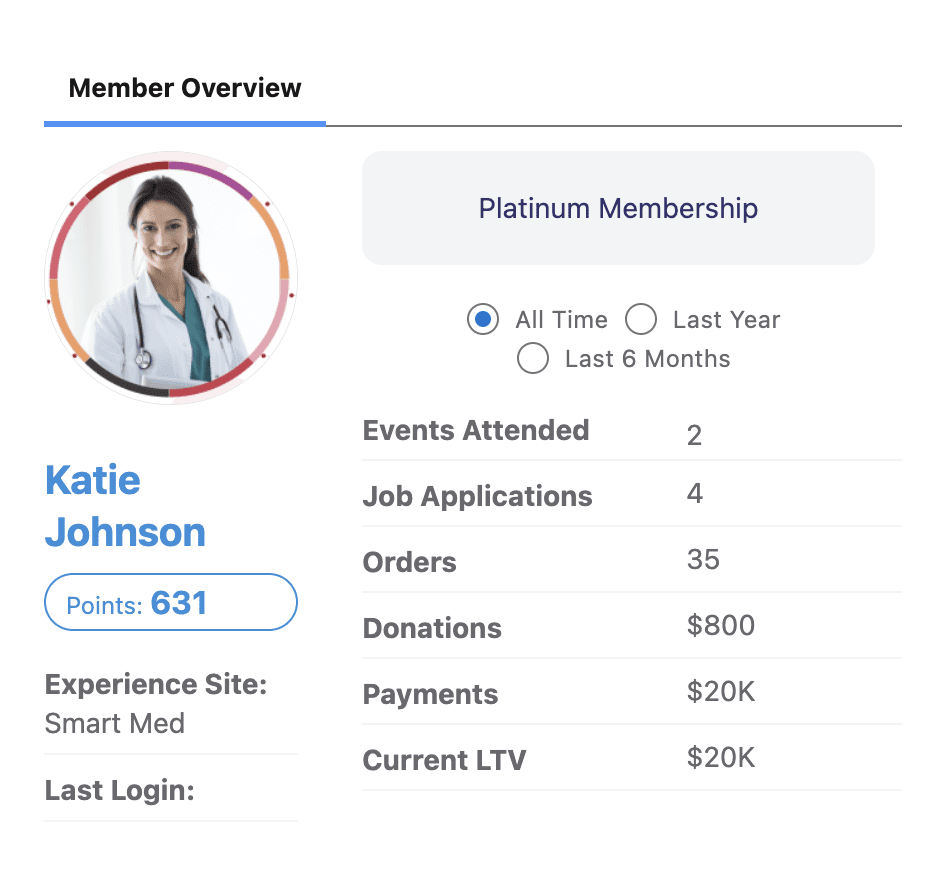
The engagement score deserves a particular mention. Rather than looking at each data point in isolation, a well-designed member profile should synthesize this data into a signal — one number or tier that tells a membership manager at a glance whether a member is highly engaged, moderately engaged, or at risk. How that score is calculated will depend on what matters most to your association, but the principle is the same: raw data becomes actionable intelligence.
Why Associations Struggle With Member Data
If the answer is “build a 360 member view,” the natural follow-up is: why don’t more associations have one?
The causes are usually a combination of legacy systems, organizational habits, and underestimated complexity:
- Legacy AMS platforms weren’t designed to be connective tissue between your event tool, payment processor, and email platform.
- Spreadsheets fill the gaps and then multiply, diverging over time with no single owner.
- Disconnected event tools mean attendance data, one of the richest engagement signals available, rarely flows back into the member record automatically.
- Separate payment systems create the same problem: knowing a member paid isn’t enough without the full context of when, how, and whether they’ve ever been in arrears.
- Manual updates introduce lag and error.
- Duplicate records split member history across two profiles.
- Weak integrations mean data flows one way, syncs nightly, or breaks silently.
The cumulative effect: your data exists, but it doesn’t cohere. And without coherence, you can’t build the understanding that drives retention, personalization, and growth.
From Member Data to Member Intelligence
Member data is facts: “This member joined in 2019. They attended two events last year. They opened three emails in March.”
Member intelligence is what those facts mean and what you should do about them. It’s the step that transforms your database from a record-keeping system into a strategic tool.
Here are some examples of what that looks like in practice:
- The At-Risk Renewer: A member hasn’t logged into your portal in 90 days. Their renewal is due in 30 days. They opened your last three email newsletters but didn’t click through to renew. This is a signal that this member needs a personal outreach from a membership coordinator, not just another automated reminder.
- The Lapsed Donor: A member donated in 2021 and 2022 but not since. They renewed on time, but their giving has gone quiet. Member data says “no donation in 18 months.” Member intelligence says “this person has demonstrated willingness to give, but something shifted, and they warrant a personalized stewardship touchpoint, not a mass fundraising email.”
This is the real promise of a member 360 view: not just knowing what happened, but being able to act on it meaningfully.
How a 360 Member View Improves Engagement
With a complete member profile, your member engagement strategies shift from broadcast to targeted. Consider what becomes possible:
Personalized Email Communications
It should reference what a member has actually done. “We noticed you attended our webinar on regulatory changes last month, so here’s our upcoming session on the same topic” lands very differently than “Check out our upcoming events.”
Contextual Event Recommendations
They should be based on past attendance. If a member has attended every governance-focused session but skipped networking events, you can surface the content they’re most likely to care about.
Smarter Onboarding Journeys
Onboarding that adapts based on what a new member does (or doesn’t do) in their first 90 days. Because a member who logs in frequently needs different messaging than one who joined and hasn’t returned.
Targeted Fundraising Appeals
Account for a member’s giving history and engagement level, rather than sending the same ask to everyone.
How a 360 Member View Supports Renewals and Retention
Retention is fundamentally a data problem. Members leave or fail to renew when they don’t feel the organization sees them or provides value. A 360° member view addresses both sides of that equation.
A well-structured membership renewal strategy built on complete association member data enables:
- At-risk member detection before the renewal window opens. If engagement scores have been declining for six months, you have time to re-engage proactively and not wait until 30 days before renewal.
- Segmented renewal campaigns that treat different members differently. A member who has renewed on time for seven consecutive years doesn’t need the same aggressive reminder sequence as someone who has lapsed twice before.
- Personalized follow-up that gives your membership team the context for a useful conversation. Knowing a member’s event history, tenure, and last support request gives that call a very different starting point than a name and an email address.
- Visibility across the team, so that no matter who picks up a member inquiry, they can see the full history and respond accordingly.
Why Salesforce Is a Strong Foundation for Member Intelligence
Building a 360 member view requires more than a better database. It requires a platform that can unify data from multiple sources into a single source of truth, automate workflows across the member lifecycle, generate flexible reports, and scale as your organization grows.
Salesforce has become the platform of choice for many forward-thinking associations because it unifies member data, engagement, payments, events, reports, and automation in a single ecosystem. Rather than maintaining separate systems with fragile integrations, everything flows into the same record: when a member registers for an event, updates their contact details in the self-service portal, or donates.
The reporting and automation infrastructure then turns that data into actionable intelligence: at-risk members flagged automatically, renewal sequences triggered by engagement thresholds, dashboards built around the metrics your board actually wants to see. And as AI for associations becomes increasingly relevant, having unified, high-quality membership data is the prerequisite, because AI tools are only as useful as the data behind them.
How AC MemberSmart Helps Build a 360 Member View
AC MemberSmart is a Salesforce-native association management system built specifically for associations that want to manage their entire membership operation inside Salesforce without building custom integrations or maintaining multiple platforms.
Rather than asking associations to bolt together separate tools for membership, events, payments, and reporting, AC MemberSmart consolidates these functions into a coherent system where every action a member takes updates a single, unified profile.
The AC MemberSmart features that directly support a 360 member view include:
- Member profiles with full history across every touchpoint
- Renewals and dues management with automated workflows and flexible billing
- Payment processing tracked at the member level, not just in a finance system
- Event registration and attendance feeding directly back into the member record
- Donations and fundraising with giving history and campaign attribution
- Directories and job board activity captured and visible in the member profile
- Self-service member portal with login tracking and engagement data
- Reporting dashboards built on Salesforce’s native reporting engine
Ready to see what a complete 360 member view looks like inside Salesforce? Contact our team, and we’ll walk through how your specific data landscape could come together in one place.
Practical Checklist: Do You Have a Real 360 Member View?
Use this checklist to assess where your organization stands today. If you find yourself answering “no” or “sort of” to several of these, you likely have data gaps that are affecting your retention, engagement, and reporting.
- Can we see each member’s current status in real time?
- Can we view payment and renewal history in one place?
- Can we see which events a member has attended?
- Can we track overall engagement at the individual level?
- Can we automatically identify inactive or at-risk members?
- Can we segment members by engagement level for targeted outreach?
- Can we report on member value (tenure, giving, participation)?
- Can we personalize communication based on member behavior?
- Do all relevant staff see the same membership data?
- Are member records updated automatically (not manually)?
Scoring guide:
- 8–10 “Yes”: You have a strong data infrastructure. Focus on deepening your analytics and personalization.
- 5–7 “Yes”: You have a partial view. Identify your biggest gaps and prioritize integration.
- Under 5 “Yes”: Your data is fragmented. A unified platform approach will have a significant impact on your operations.
Conclusion
A 360 member view isn’t a reporting feature or a nice-to-have. It’s the operational foundation that makes personalization, retention, and meaningful analytics possible. Without it, your team is reacting rather than anticipating. The associations that invest in this infrastructure now will have the data quality to take advantage of whatever comes next, whether that’s AI-powered member engagement, deeper reporting, or simply a membership team that can do their jobs without fighting their systems every day.
Want to see what a complete 360 member view can look like inside Salesforce? Book a personalized AC MemberSmart demo and let’s explore what’s possible for your association.
FAQ
What's the difference between a CRM and a 360° member view?
A CRM is a platform; a 360° member view is a standard. Your CRM might store contact records, but unless it also captures payment history, event attendance, engagement data, and support history in a unified profile, it’s not giving you a full picture. A 360° member view is what a well-configured AMS or CRM should produce.
Do we need to collect all of this data from day one?
No. Start with the essentials: contact details, membership status, renewal date, payment history, and event participation. Once those are unified, you can layer in engagement scoring, portal activity, and behavioral signals over time. A phased approach is more realistic than trying to build the perfect profile immediately.
What's an engagement score, and how is it calculated?
An engagement score is a composite metric reflecting how actively a member participates in your organization. It typically factoring in event attendance, portal logins, email engagement, community activity, and tenure. The weighting depends on your organization’s priorities. A Salesforce-native AMS like AC MemberSmart can calculate this automatically based on real-time activity data, giving your team a quick signal of member health without manual reporting.