


Every association board eventually arrives at the same conversation: members expect more each year, but raising dues is a difficult sell. So the search begins for benefits that add real value without adding cost pressure or another disconnected tool nobody maintains.
One of the most consistently underestimated options is the job board.
It’s easy to dismiss. A page with open roles doesn’t sound transformative. But when a job board is built around your professional community and connected to your membership data, it stops being a listings page: it becomes a career resource members return to, a reason employers engage with your organization, and a channel that can generate non-dues revenue.
This article looks at the job board for assicoations as part of member value ecosystem: what it does for members, what it can do for your budget, and what has to be true for it to work.
Table of Contents
Why Member Benefits Need to Go Beyond Discounts and Newsletters
The traditional benefits package (a members-only newsletter, partner discounts, a printed directory) was designed for a time when information itself was scarce. That scarcity is gone. Members can find industry news, peer opinions, and vendor pricing without a membership card.
What they can’t easily replicate is access: to the right people, the right opportunities, and the right professional standing within a defined community.
That shifts the question for membership teams. Instead of “what can we offer?”, ask “what does membership make possible that isn’t possible otherwise?” Most answers cluster around a few themes:
- Career growth: advancement, transitions, and new opportunities
- Networking: meaningful connections inside a specific professional circle
- Learning: skills and credentials tied to the profession
- Visibility: being seen by peers, employers, and the wider industry
- Practical opportunities: work, projects, speaking, leadership roles
- Professional development: a long-term path, not a single event
A job board touches at least four of those directly. That’s unusual for a benefit that many associations still treat as optional. If you’re auditing your current offering, it’s worth reviewing alongside your broader member engagement strategies rather than as a standalone feature request.
What Is an Association Job Board?
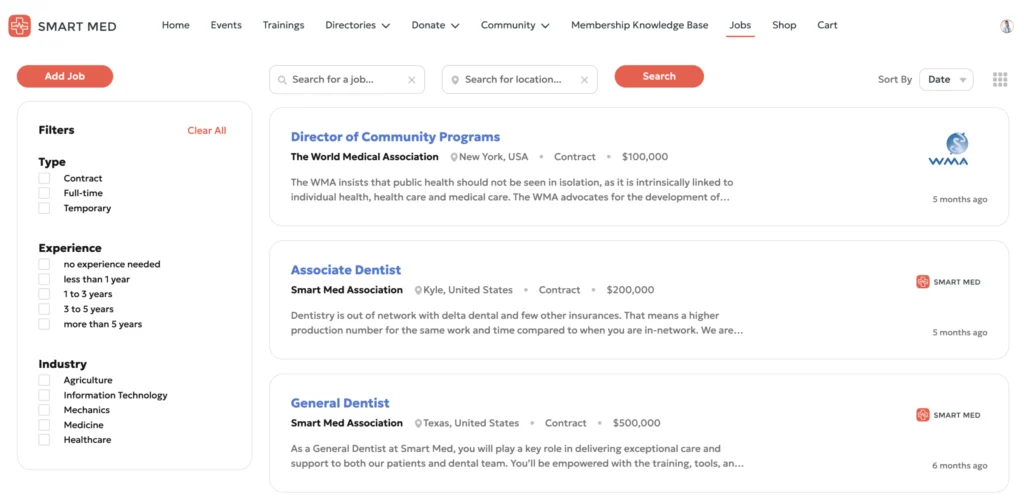
An association job board is a job listing platform built for the professional or trade community your association serves. That focus is the whole point.
General job sites optimize for volume. An association job board optimizes for fit. Employers posting there want people in your field, often with the credentials, certifications, or specializations your association represents. Candidates browsing it are already inside the profession.
In practice, that usually means:
- Listings restricted to your industry, discipline, or geography
- Employers who understand what your members actually do
- Roles that may never be advertised on mainstream platforms
- Optional member-only access to some or all postings
- A connection to member profiles, credentials, and membership status
The result is a smaller, denser marketplace. For a specialized profession, that density is worth more than reach.
How Job Boards Increase the Value of Association Membership
The clearest argument is also the simplest: for a member weighing renewal, a single relevant job lead can justify the annual fee outright. Few benefits carry that kind of direct payoff, and fewer still deliver it at the moment a member is deciding whether to stay.
The value doesn’t stop at individual placements. A job board makes the professional ecosystem visible: who’s hiring, which skills are in demand, how the field is shifting. Members get a read on their profession, not just a list of vacancies, and that context is useful even to those who aren’t looking to move.
It also solves a quieter problem. Most association touchpoints run on a schedule set by staff: a renewal notice, an annual conference, a quarterly newsletter. Career interest doesn’t follow that calendar. A job board gives members a reason to log in between those moments, which is when memberships tend to go dormant.
Employers benefit too, and they are part of your ecosystem, often already corporate members, sponsors, or exhibitors. A job board gives them something concrete and recurring rather than a once-a-year sponsorship conversation.
Taken together, these effects support retention. Members who use a benefit are easier to keep than members who have forgotten it exists, and career-stage members in particular renew when membership feels connected to their professional trajectory. That logic runs through the whole lifecycle, which is why a job board belongs alongside broader efforts to increase the value of membership.
Job Boards as a Source of Non-Dues Revenue for Associations
Job boards are one of the few member benefits that can pay for themselves. Revenue depends entirely on audience size, industry hiring patterns, and how employers already perceive your organization, so model it conservatively.
Common approaches include:
- Paid job postings: a flat fee per listing, often with tiered durations
- Featured listings: premium placement at the top of results
- Employer packages: bundled postings sold annually to frequent recruiters
- Sponsor placements: banner or category sponsorship of the board itself
- Member-only access: job seeker access as a membership differentiator
- Premium visibility for candidates: profile highlighting or early access to new roles
Most associations start with one model (usually paid postings) and expand once demand is proven. A useful early test costs nothing: ask three or four employer members whether they’d pay to post, and what they currently spend recruiting for those roles.
Be realistic about effort, too. A board needs listings to be worth visiting, and early listings usually require outreach rather than inbound interest.
How a Job Board Supports Member Engagement
Engagement is usually measured in logins, clicks, and time on the portal, but what those metrics really track is whether your platform stays relevant between renewal cycles.
A job board contributes in a few ways. Members visit on their own schedule, driven by curiosity or intent rather than a campaign. Employers interact with you outside the sponsorship conversation. And every interaction produces signal: which roles get attention, which specializations are in demand, which members are exploring career moves.
That signal is useful. Job activity can enrich the member profile alongside event attendance, course completions, and committee participation. A member browsing senior roles has different needs than one browsing entry-level postings, and that difference should inform how you communicate with them.
Why Job Boards Should Be Connected to Membership Data
This is where many association job boards fall short. The board is added as a separate plugin or third-party subscription, sitting outside the systems that hold member data. It works, but it’s an island.
The consequences show up quickly. Access rules are managed manually. Payments live in a separate ledger. Employer accounts don’t match your organizational records. Engagement data never reaches your reports. And when a membership lapses, access doesn’t change until someone notices it.
A connected job board shares the same foundation as the rest of your operations:
- Member profiles so access and personalization reflect who the member is
- Membership status so lapsed members lose access automatically
- Access permissions so tiers, chapters, and categories are enforced by rule
- Payments so posting fees flow through the same financial process as dues
- Employer accounts so companies are recognized as organizations, not loose contacts
- Reporting and engagement analytics so job activity appears in the same dashboards as everything else
It’s the same argument for consolidating any member-facing function into your association management system: every disconnected tool adds administrative work and subtracts visibility.
How AC MemberSmart Supports Job Boards Inside a Membership Ecosystem
AC MemberSmart is a Salesforce-native association management platform, and job boards sit inside that ecosystem rather than beside it.
Because the platform is built on Salesforce, a job board shares the same member records, permissions model, and reporting layer as everything else. The member portal, member data, payments, directories, events, and reports draw on one source of truth, so a posting fee is recorded like any other transaction and job activity appears in the same engagement view as event registrations.
Practically, access rules follow membership status automatically, employer accounts connect to existing organizational records, and you can report on job board performance next to renewals rather than in a separate export. For teams working to improve member retention, that unified view matters more than any single feature. You can explore the full set of Salesforce-native membership management features to see how the pieces connect.
Checklist: Is a Job Board Right for Your Association?
Work through these honestly before committing:
✔️ Do your members actively look for career opportunities in your field?
✔️ Do employers want access to your audience, and have they said so?
✔️ Could job postings realistically generate non-dues revenue at your scale?
✔️ Would job activity meaningfully increase portal engagement?
✔️ Do you have the data to manage access, permissions, and reporting?
✔️ Can the job board be connected to your AMS rather than run separately?
Four or more yes answers suggest a strong case. Two or fewer means your effort is better spent elsewhere for now.
Conclusion
A job board isn’t just a list of vacancies. When it’s executed well, it’s a career resource that makes membership tangible, an engagement driver that brings members back between renewal cycles, and a channel that can offset its own cost.
The difference between a job board that works and one that quietly fades comes down to integration. A board connected to member profiles, status, payments, and reporting compounds in value. A standalone plugin becomes one more thing to maintain.
If your members are building careers in your industry, the question isn’t whether to offer a job board; it’s whether yours is connected to everything else you know about them.
See how AC MemberSmart helps associations manage job boards, member benefits, payments, engagement, and reporting inside Salesforce. Book a personalized demo.
FAQ
How many members do we need before a job board makes sense?
There’s no fixed threshold. Concentration matters more: a focused community of a few thousand professionals in a specialized field can be more attractive to employers than a much larger but broadly defined membership.
Should job listings be members-only?
A hybrid is common: listings visible to everyone, with full details, early access, or application features reserved for members. That preserves the membership incentive while keeping the board attractive to employers who want reach.
Who maintains the listings?
In most models, employers post directly through a self-service flow, with staff reviewing submissions before publication. Manual posting by staff doesn’t scale beyond the earliest stage.
Can a job board work alongside an existing careers page?
Yes, and many associations start there. The upgrade path is usually adding employer self-service, payments, and member data connections rather than replacing the page.
How do we measure whether it's working?
Track listing volume, unique member visitors, repeat visits, employer retention, and posting revenue, then compare renewal rates between members who use the board and those who don’t.