


Almost no association sets out to build a fragmented tech stack. It accumulates, one reasonable decision at a time.
The board approves an annual conference, so the events coordinator signs up for a registration tool. Dues renewals get messy, so someone builds a tracking spreadsheet. The membership committee wants a searchable directory, so a plugin goes on the website. A capital campaign launches, so a donation form appears. Each of those choices was defensible in the month it was made.
Five or six years later, the same association is running membership operations across eight or nine systems that don’t share a single member record. And a question that should take two clicks, for example, how many lapsed members attended one of our events last year? takes two days and a volunteer with strong spreadsheet skills.
That gap is the real dividing line between a set of point AMS solutions and an association management platform. It isn’t about price or feature checklists. It’s about whether your operations share one version of the truth about each member.
Table of Contents
What Are Point Solutions?
A point solution is software built to do one job. In the association world, that usually means:
- an event registration tool
- a payment processor
- an email marketing platform
- a form builder
- a spreadsheet used as a database
- a standalone donation form
- a job board plugin
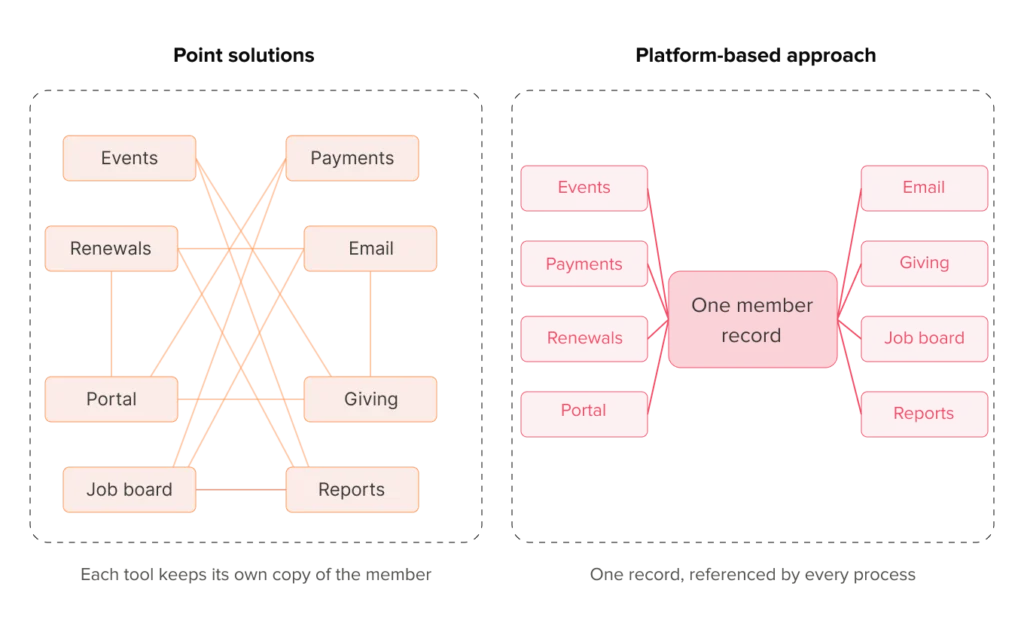
Point tools are frequently very good at their narrow task. In isolation, they are better than the equivalent module inside a broader suite. That’s not the issue. The issue is structural: each one maintains its own copy of member data, its own definition of “member,” and its own idea of who currently counts as active. If you’re still mapping the territory, our guide to AMS for associations covers what this category of software is expected to cover.
Why Associations Often Start With Point Tools
It’s worth being honest about why fragmentation is the default, and not a failure of judgment:
- Speed. A registration tool can be live before lunch. An implementation project takes a quarter.
- Lower entry cost. A monthly subscription fits inside a departmental budget line.
- Familiarity. Someone on staff already knows the tool from a previous job.
- No implementation project. No discovery, no data migration, no change management.
- One urgent problem. The association needed to solve this thing, this month.
There’s also a governance reason that rarely gets named: point tools are bought by departments, while platforms are bought by organizations. A $40/month tool needs one manager’s approval. A membership platform needs the executive team, IT, and often the board. So the path of least resistance almost always produces a fragmented tech stack, until the cost of fragmentation gets loud enough to reach the board agenda.
The Problem: Point Tools Create Fragmented Membership Operations
Fragmentation rarely announces itself as an outage. It shows up as work — recurring, invisible, unbudgeted work.
In discovery sessions with association teams, we tend to ask one deliberately simple question: if the same person renewed their membership, made a donation, and registered for a chapter event last quarter, which of your systems knows all three things happened? The answer is almost always “none of them; someone puts that together by hand before the board meeting.”
Here’s what that looks like in practice:
- Data silos. Renewal history lives in one place, event attendance in another, giving history in a third. No system holds the whole picture.
- Duplicate records. The same member exists as three different people because they registered with a work email, a personal email, and a slightly different name spelling.
- Manual exports and imports. Call it the reconciliation tax: hours each month spent moving CSVs between systems so that reports approximately agree.
- Inconsistent member experience. Members log in separately to register, pay, update a profile, and browse jobs, and reasonably conclude the association is disorganized.
- Weak reporting. Board-level questions about retention or engagement can’t be answered from one query, so they get answered from an assembled snapshot that’s already out of date.
- Integration maintenance. Connectors need owners. Every vendor API change quietly becomes your problem.
- Unclear ownership. When two systems disagree, nobody can say which one is the source of truth.
- No complete member view. Staff can’t see a member’s full relationship with the organization at the moment they’re talking to them.
Connectors help, and choosing them well matters, which is why we’ve written about membership management software integrations in detail. But an integration synchronizes two data models; it doesn’t replace them with one. That distinction is the whole argument.
What Is a Platform-Based Membership Management Approach?
A platform-based approach means the core of your membership operations runs inside one ecosystem, on one shared data model, with one automation layer and one reporting layer on top of it.
Typically that covers:
- the member database
- renewals
- payments
- events
- fundraising
- job board
- member portal
- reporting
- automation
An important clarification: platform-based doesn’t mean “one vendor for absolutely everything.” Most associations will still use specialist tools somewhere. It means there is one system of record that everything else defers to, so when a renewal is processed, every dependent process (portal access, directory listing, event pricing tier, engagement scoring) updates from the same event rather than from a nightly file transfer.
Platform-Based vs. Point Solutions: Side-by-Side Comparison
| Criteria | Point Solutions | Platform-Based Approach |
|---|---|---|
| Data management | Separate databases per tool; each holds a partial copy of the member | One member record referenced by every process |
| Integrations | Required between every pair of tools; ongoing maintenance | Mostly internal; external integrations connect to one hub |
| Reporting | Manual consolidation across exports; numbers often disagree | Cross-functional reporting from a single dataset |
| Member experience | Multiple logins, inconsistent branding, repeated data entry | One portal, one login, profile data reused across journeys |
| Automation | Limited to each tool’s own boundary | Cross-process automation (e.g. renewal triggers portal, directory, and pricing updates) |
| Scalability | Each new need adds a tool and another integration to maintain | New capability extends the existing model |
| AI readiness | Fragmented, inconsistent data limits what AI can be trusted with | Consolidated, structured history is usable input |
| Team efficiency | Staff time absorbed by exports, reconciliation, and rework | Staff time spent on member programs |
| Total cost over time | Low entry cost; rising integration, admin, and staff-time cost | Higher setup investment; flatter operating cost as you grow |
When Point Solutions Are Still Acceptable
Platform thinking isn’t automatically right. Point tools remain a sensible choice when:
- the organization is small, and the whole team fits in one meeting
- processes are simple and don’t branch by membership type
- there’s no Salesforce or comparable platform in place, and no plan to adopt one
- you need a temporary solution for a one-off program or pilot
- budget is genuinely constrained, and capital investment isn’t available
- reporting needs stop at “how many people registered?”
If that describes your association, adding a platform would add cost and complexity without solving a problem you actually have.
When a Platform-Based Approach Makes More Sense
The balance shifts when:
- membership is growing and manual processes are visibly straining
- you manage multiple membership tiers, chapters, or organizational memberships
- renewals, payments, events, and fundraising all need to coexist
- personalization matters, and personalization requires knowing what a member has already done
- leadership wants reporting they can trust without a preparation cycle
- Salesforce is already in the organization
- automation or AI is on the roadmap
That last point deserves emphasis. Automated membership renewals only work reliably when the system driving them can see payment status, tier, and engagement history in one place. The same is true for AI: models are only as useful as the data underneath them, which is why AI-ready membership data is a prerequisite rather than a follow-up project.
How Salesforce Supports a Platform-Based Membership Ecosystem
Salesforce is useful in this context less as an application and more as a foundation. It supplies the layers that a fragmented stack keeps duplicating: a configurable data model, granular permissions, reporting and dashboards, an automation engine, and an app ecosystem that extends the same records rather than copying them.
A Salesforce-native AMS software for associations is built inside that foundation. Membership, events, payments, and giving become objects and processes in the same environment your team already uses for relationships and reporting, so extending the association management system later means configuration, not another integration to own.
How AC MemberSmart Replaces Fragmented Tools With One Membership Ecosystem
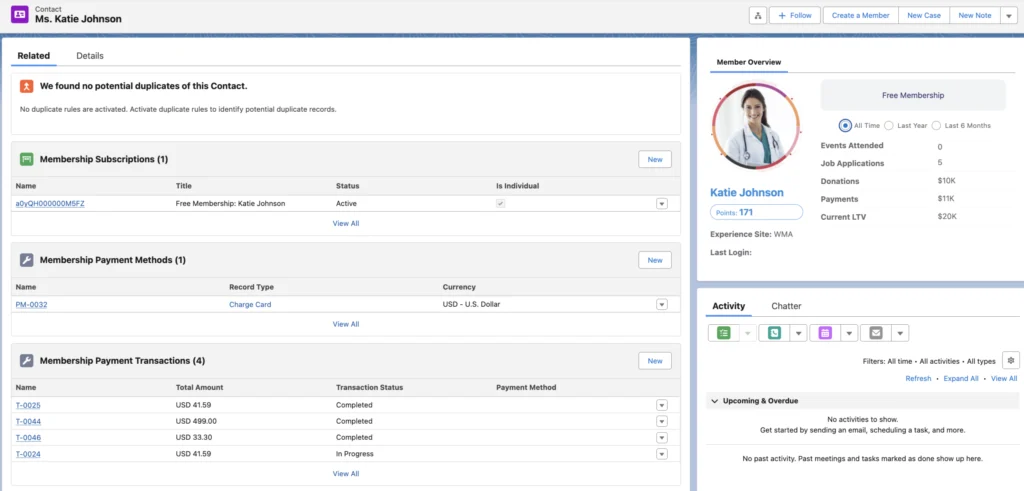
AC MemberSmart was built to consolidate the tools associations most often end up running in parallel. Because it’s Salesforce-native, the membership lifecycle (join, engage, renew, lapse, reinstate) is modeled on the same records as everything else, alongside renewals, payments, events, donations, a job board, member directories, reporting, and a self-service portal.
The practical effect our implementation teams see is less about new features and more about work disappearing: monthly reconciliation between systems stops being a task, and questions that used to require an export can be answered from a dashboard.
Curious what that consolidation would look like for your data? You can review the AC MemberSmart features and map them against the tools you’re currently paying for.
Explore how AC MemberSmart helps associations replace fragmented tools with a connected Salesforce-native membership management platform. Book a personalized demo.
Conclusion
A point solution solves a task. A platform supports an organization.
That’s not a criticism of point tools. They earn their place, and many associations should keep using them. But if your team is spending real hours each month making systems agree with each other, the bottleneck isn’t the quality of any individual tool. It’s the absence of a shared member record underneath them. Solving that is what a platform-based approach is actually for.
FAQ
Is an association management platform the same as association management software?
Broadly, “association management software” describes the category. “Platform” describes an architectural choice within it: whether capabilities share one data model and automation layer, or operate as separate applications that exchange files.
Can we move to a platform gradually?
Yes, and most associations do. The usual sequence is to establish the member record first, then migrate the processes that depend on it most heavily (typically renewals and payments) before consolidating events, giving, and the portal.
Do we have to abandon a point tool our team likes?
Not necessarily. A platform-based approach requires one authoritative source of member data, not the elimination of every specialist tool. The test is whether that tool reads from the system of record instead of maintaining a rival copy.
What usually makes consolidation harder than expected?
Data quality, almost always. Duplicate records and inconsistent membership definitions that were tolerable when each system was judged separately. Cleanup is part of the project, not a preliminary to it.