


Walk into any association’s back office and you’ll likely find the same story: membership data sitting in one system, event registrations tracked in a spreadsheet, payments processed through a separate payment tool, and emails going out from yet another platform. Add a member portal, a finance integration, and maybe a job board, and you have a patchwork of tools that rarely talk to each other cleanly.
The result? Staff waste hours on manual data entry. Reporting is a weekend project. And members feel the friction every time they log in, renew, or register for an event.
In 2026, choosing an association management system (AMS) is no longer just about where to store your member records. It’s about choosing the entire digital infrastructure your organization will run on for the next five to ten years. The stakes are high, and so is the confusion between the two dominant architectural choices: AMS on Salesforce vs standalone AMS.
This guide breaks down the real differences, when each approach makes sense, and what questions to ask before you commit.
Table of Contents
What Is a Standalone AMS?
A standalone AMS is a self-contained software platform built specifically to manage association operations, such as membership records, dues collection, event registration, committee management, and communications — all in one dedicated system, operating independently from any CRM.
Products in this category have typically been built from the ground up for the association world, which means they often arrive with a library of pre-configured workflows that reflect how trade associations, professional societies, and nonprofits typically operate. For many organizations, that out-of-the-box familiarity is genuinely appealing.
If you want a deeper primer on what an AMS system is and how the category has evolved, that context is worth reviewing before diving into the comparison below.
| Advantages | Limitations |
|---|---|
| Faster initial implementation for straightforward needs | Creates data silos separate from your CRM |
| Pre-built association-specific workflows and terminology | Complex integrations with marketing, finance, and analytics tools |
| No Salesforce license or Salesforce expertise required | Limited flexibility for non-standard processes |
| Lower entry cost for small organizations | Harder to scale as your tech stack grows |
| AI and automation capabilities often lag behind CRM-native platforms |
What Is an AMS on Salesforce?
Salesforce itself is not an AMS. It’s a CRM platform — a powerful foundation for managing relationships, data, workflows, and integrations. What makes it relevant to associations is that developers have built purpose-built AMS products directly on top of the Salesforce platform, taking full advantage of its data model, automation engine, reporting tools, and app ecosystem.
This is a meaningfully different architecture from a standalone AMS that simply “integrates with Salesforce.” A Salesforce-native AMS doesn’t sync data between two separate systems; it lives inside Salesforce, which means there’s one database, one security model, one automation layer, and one reporting environment for everything your organization does.
Key distinction
An AMS that “connects to” Salesforce is still two systems that need to stay synchronized. A Salesforce-native AMS is Salesforce, extended and configured specifically for associations.
AC MemberSmart is built on this native model. Rather than syncing data back and forth, it extends Salesforce directly, so membership management, event registration, payments, fundraising, and member portal activity all live in a single environment, alongside any other Salesforce tools your team uses. More on that below.
Salesforce AMS vs. Standalone AMS: Key Differences
Here’s how the two approaches compare across the dimensions that matter most for association operations:
| Criteria | Standalone AMS | AMS on Salesforce |
|---|---|---|
| Data management | Separate database. Requires syncing with other tools | Single source of truth. All data in one Salesforce org |
| Member portal | Typically included, though customization is limited | Fully customizable self-service portal via Salesforce Experience Cloud |
| Integrations | Pre-built connectors. Additional integrations can be complex | Native access to the full Salesforce ecosystem and AppExchange |
| Payments & renewals | Built-in payments. Renewal automation varies by vendor | Flexible payment processing with advanced renewal automation |
| Reporting & analytics | Standard reports. Custom reporting is often limited | Salesforce Reports & Dashboards are highly configurable |
| Automation | Workflow automation scoped to AMS features | Salesforce Flow enables automation across all operations and data |
| Flexibility | Moderate. Customization constrained by the vendor’s data model | High. Salesforce’s platform adapts to complex or unique processes |
| AI readiness | AI features are dependent on the individual vendor’s roadmap | Salesforce Einstein AI and Agentforce are available across the platform |
| Implementation complexity | Generally faster to start | Longer initial setup. Pays off at scale |
| Long-term scalability | Moderate. Depends on vendor investment | High. Grows with Salesforce platform capabilities |
Choose a standalone AMS if your association has simple membership tiers, limited integration needs, and no Salesforce roadmap. Choose an AMS on Salesforce if you need a single source of truth, advanced reporting, member self-service, event and payment workflows, automation, and long-term scalability. For associations already using Salesforce or planning to build around it, AC MemberSmart offers a Salesforce-native way to manage membership without creating another disconnected system.
When a Standalone AMS May Be Enough
This comparison shouldn’t be read as a verdict against standalone AMS platforms. For some organizations, they’re a perfectly reasonable choice, and it’s worth being clear about when.
A standalone AMS is likely a good fit if:
- Your association is small, with a relatively simple membership structure
- You don’t currently use Salesforce and have no plans to
- Your member management processes are straightforward: basic dues, a single tier, standard event registration
- You don’t need deep segmentation or complex membership database queries
- Cross-system integration with CRM, marketing automation, or finance is not a near-term priority
- Your primary goal is getting member data organized, not building a connected digital experience
There’s no shame in starting here. Many associations have run well on standalone AMS systems for years. The question is whether those systems can continue to meet the demands of a more connected, automated, and member-centric future.
When a Salesforce-Based AMS Makes More Sense
The calculus changes substantially once an organization’s complexity, ambitions, or existing tech stack grows past a certain threshold.
An AMS on Salesforce starts to make significantly more sense when:
- You already use Salesforce. Adding a native AMS keeps everything in one place rather than creating a second system
- You want a single source of truth. Member data, engagement history, event attendance, and payment records unified in one database
- Reporting matters. You need cross-functional dashboards that combine membership metrics with fundraising, events, or engagement data
- Your processes are complex. Multiple membership tiers, tiered pricing, CPD/CPE tracking, certification workflows, or sophisticated renewal logic
- Members expect self-service. A configurable member portal where contacts can update their profile, renew, register for events, and manage their membership independently
- Automation is a priority. Automating membership renewals, lapsed member re-engagement sequences, and event follow-ups without manual intervention
- You’re thinking about AI. Salesforce’s Einstein and Agentforce are already embedded in the platform, making it far easier to build intelligent, personalized member experiences as that technology matures
Important Note
Native membership software integrations don’t require maintaining API connections between separate systems, reducing the maintenance burden and data inconsistency risk that comes with stitching tools together.
Want to see a live member portal and get a look at how Salesforce-native AMS works in practice? No slides, just the product ⬇️
The Biggest Risk: Choosing an AMS That Cannot Grow With You
The most expensive AMS decision isn’t choosing the wrong tool today; it’s being locked into a tool that can’t support what your organization needs in three years.
Associations rarely stay static. Programs expand. Membership categories multiply. Leadership starts asking for dashboards that don’t exist yet. A job board gets added. The community platform needs to connect to member profiles. Fundraising goals increase. And eventually, someone asks about AI-powered personalization.
A standalone AMS built around today’s processes can become a ceiling rather than a foundation. When the roadmap is controlled entirely by an external vendor, and that vendor’s priorities don’t align with yours, you’re dependent on their product decisions.
Consider where your organization might want to be in 2028:
- Multiple membership tiers with dynamic pricing
- Integrated fundraising and donation management
- Event management with sponsorship tracking
- A member-facing job board
- Online communities tied to membership status
- Advanced analytics connecting engagement data to retention risk
- AI-driven personalization for member journeys
Salesforce has native capabilities or AppExchange solutions for every one of these. A standalone association management software may address some of them, but likely requires additional integrations, additional vendors, and additional complexity to do so.
Decision Checklist: Which AMS Is Right for Your Association?
Before choosing, run through these questions honestly. The more you answer “yes,” the stronger the case for a Salesforce-based AMS.
- Are we already using Salesforce for any part of our operations?
- Do we need a single, reliable source of truth for all member data?
- Are we currently working around limitations in spreadsheets or disconnected tools?
- Do our leadership and board expect real-time reporting and dashboards?
- Do members expect self-service access to their records, renewals, and events?
- Do we want to automate renewals, payments, and lapsed member outreach?
- Do we plan to expand programs, tiers, or services over the next 2–3 years?
If you still have questions after reading this comparison, check out the recording of the Ask Us Anything: 20 Minutes on AC MemberSmart session, a short, practical Q&A where our team walks through implementation timelines, renewal automation, and what makes a Salesforce-native AMS different.
How AC MemberSmart Helps Associations Build an AMS on Salesforce
AC MemberSmart is a Salesforce-native AMS built entirely within Salesforce, without separate databases, middleware, or sync processes. Everything your association needs to manage members is part of your Salesforce org.
The Salesforce-native membership management features include:
- Membership management
- Renewals & dues automation
- Payment processing
- Event management
- Fundraising & donations
- Job board
- Member directories
- Reporting & analytics
- Self-service member portal
- Committee management
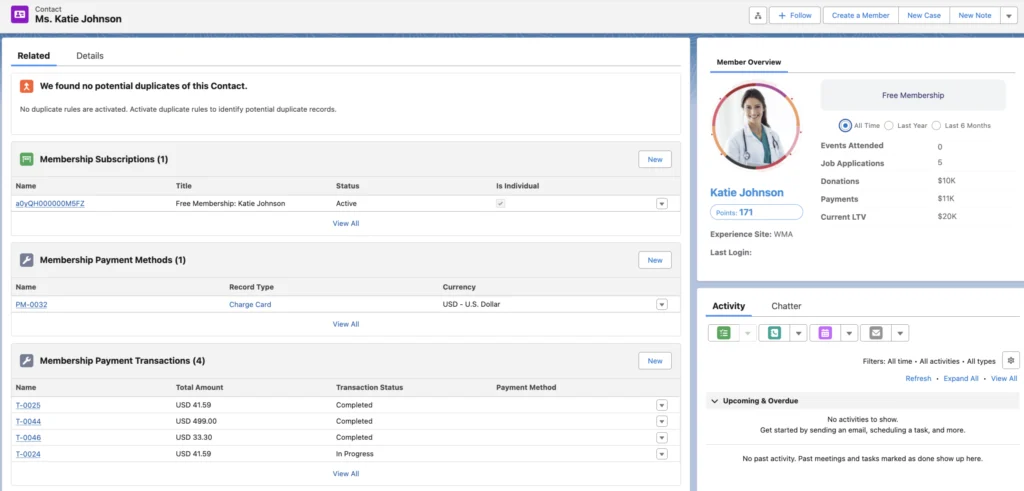
Because everything runs natively inside Salesforce, associations using AC MemberSmart benefit from the full Salesforce platform, including automation through Salesforce Flow, reporting through native dashboards, and access to the entire AppExchange ecosystem for additional capabilities as needs evolve.
For organizations already on Salesforce, the path is straightforward: rather than running a separate AMS alongside your CRM, you extend your existing environment. For organizations evaluating Salesforce for associations for the first time, MemberSmart provides a structured entry point with purpose-built association functionality already in place.
Conclusion
Standalone AMS software for associations has served the association world for decades, and they remain a practical option for smaller organizations with simple needs and no existing CRM investment. There’s no reason to overcomplicate what doesn’t need complicating.
But for associations that are growing, that already operate on Salesforce, or that are investing in a modern member experience, the limitations of a standalone system become real constraints. Data silos, integration overhead, limited reporting, and a ceiling on automation are costs that compound over time.
An AMS built natively on Salesforce addresses these limitations by design: one data model, one automation layer, one reporting environment, and a platform that will continue to grow alongside your organization’s ambitions.
The question worth asking isn’t just “which AMS is cheapest to start?” but “which AMS will still be serving us well in five years?”
Ready to See What a Salesforce-Native AMS Looks Like in Practice?
See how AC MemberSmart helps associations manage members, renewals, payments, events, and engagement directly inside Salesforce. Book a personalized demo today.
FAQ
Does my association need to already be on Salesforce to use a Salesforce-native AMS?
No, you don’t need to already be a Salesforce customer. Many associations adopt a Salesforce-native AMS like AC MemberSmart as their first Salesforce product. The AMS provides the structured entry point, and the broader Salesforce platform is available as your needs expand. That said, organizations already on Salesforce tend to see the most immediate value.
Are Salesforce-native AMS platforms more expensive than standalone AMS?
Upfront implementation costs can be higher, and Salesforce licensing is an additional factor to budget for. However, the total cost picture often shifts when you account for the tools a standalone AMS requires to match the same capabilities: separate CRM, separate marketing automation, separate reporting infrastructure. The Salesforce platform consolidates many of those costs into one environment.
Can a Salesforce-native AMS replace our existing tools for events, payments, and portals?
In most cases, yes. A full-featured Salesforce-native AMS like AC MemberSmart includes event management, payment processing, member portal, fundraising, and job board capabilities — all within the same platform. This is one of the primary reasons organizations move from a patchwork of tools: the goal is fewer systems, not more.